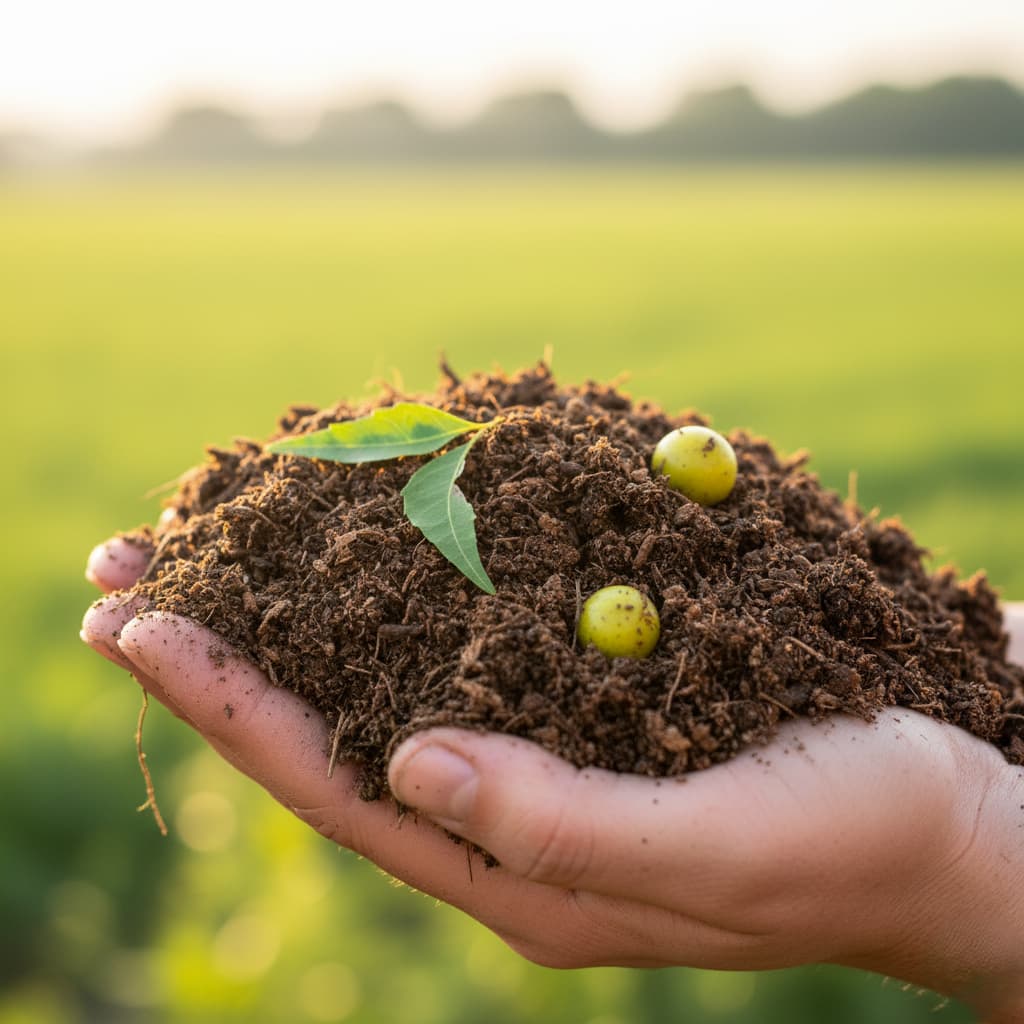
The Need for Smarter Organic Solutions
In today’s era of sustainable agriculture, farmers and agri-businesses are actively searching for natural alternatives that can restore soil health and reduce chemical dependency. Among the many natural resources India has been blessed with, Neem (Azadirachta indica) stands out as one of the most powerful and versatile gifts of nature.
For centuries, Neem has been used in traditional farming to enrich soils, protect crops, and maintain ecological balance. But today, science has validated what farmers have known for generations — that Neem, when used in organic compost, can significantly enhance its nutrient profile, microbial balance, and pest resistance.
Let’s explore how Neem works its magic within compost — and why integrating Neem-based products into composting is a step toward healthier soils and sustainable yields.
What Makes Neem a Game-Changer in Composting?
Neem is more than just a tree; it’s a biochemical powerhouse. Its seeds, leaves, bark, and cake contain over 150 biologically active compounds, including azadirachtin, nimbin, and salannin, which offer antifungal, antibacterial, and insecticidal properties.
When Neem derivatives such as Neem cake, Neem powder, or Neem-based formulations are mixed with compost, they work in multiple ways:
- Control harmful pathogens that often breed in compost piles.
- Regulate nitrogen release, ensuring a steady nutrient supply for crops.
- Suppress soil-borne pests and nematodes.
- Enhance microbial activity that accelerates decomposition and humus formation.
In simple terms, Neem acts as both a protector and enhancer of compost quality — improving not just its nutrient balance but also its long-term soil-building capacity.
1. Neem’s Role in Improving Compost Nutrient Balance
A key issue with traditional composting is the rapid loss of nitrogen, often caused by volatilization during decomposition. Neem compounds naturally slow down the nitrification process. This means nitrogen stays longer in the compost in an available form, preventing losses and ensuring plants receive a sustained nutrient supply.
Neem also enriches compost with additional nutrients such as calcium, magnesium, sulfur, and trace minerals — vital for plant growth and soil fertility.
Key Benefits:
- Higher nitrogen retention and better C:N ratio balance
- Improved mineral availability
- Reduced nutrient leaching into groundwater
- Enhanced overall compost fertility
This slow-release nutrient property makes Neem-enriched compost ideal for long-term soil productivity and reduced fertilizer inputs.
2. Neem as a Natural Pest and Disease Suppressant
Pests and pathogens are natural enemies of compost quality. During composting, especially when kitchen waste or farm residues are used, flies, nematodes, and fungal infections can often contaminate the mixture. Here’s where Neem plays its second crucial role. Neem compounds act as natural bio-pesticides, inhibiting the growth of harmful microbes while allowing beneficial decomposers to thrive.
- Azadirachtin prevents insect larvae from maturing.
- Nimbidin and salannin suppress soil pathogens such as *Fusarium* and *Pythium*.
- Antifungal compounds in Neem protect compost from mold infestations.
This selective action ensures that Neem compost remains biologically active and clean, without the risk of transmitting harmful agents to the soil or crops.
Result: Cleaner, pest-free compost that supports healthy root development and reduces the need for chemical soil disinfectants.
3. Neem Boosts Beneficial Microbial Activity
Good compost is teeming with life — beneficial bacteria, fungi, and actinomycetes that drive decomposition and humus formation. Neem doesn’t just protect these microbes; it stimulates their growth by providing a balanced organic substrate.
Neem cake, when added to compost, acts as a **microbial activator**. It helps maintain optimal moisture and aeration, while the natural compounds in Neem create a favorable environment for beneficial microbes such as *Trichoderma* and *Azotobacter* to flourish. As a result, composting becomes faster, more uniform, and produces a rich, **humus-laden compost** that can be directly applied to crops without fear of toxicity or imbalance.
4. Neem Compost and Soil Health Regeneration
The benefits of Neem-based compost don’t end at the composting stage — they extend deep into the soil. When applied to fields, Neem-enriched compost improves soil texture, water retention, and aeration. The presence of organic carbon and bioactive compounds encourages root proliferation and enhances soil aggregation. Additionally, Neem compounds help reduce salinity and alkalinity in degraded soils, gradually bringing them back to fertility.
Long-Term Impacts:
- Increases soil organic matter
- Restores microbial diversity
- Enhances cation exchange capacity (CEC)
- Improves soil resilience to drought and erosion
This regenerative quality makes Neem compost a cornerstone for sustainable and climate-resilient farming systems.
5. Environmental Benefits: Carbon Sequestration and Waste Reduction
Neem composting is not only good for soil and plants — it’s good for the planet. By integrating Neem-based materials into composting, farmers and agri-industries contribute to **carbon sequestration** — capturing and storing carbon in the soil. This helps mitigate greenhouse gas emissions from organic waste.
Neem also reduces the dependency on synthetic fertilizers, which are often carbon-intensive to produce. Moreover, Neem cake and other by-products make use of agro-industrial residues, minimizing waste and promoting circular economy practices in agriculture.
Eco-Advantages of Neem Compost:
- Reduced methane emissions from compost piles
- Better carbon capture through humus formation
- Natural alternative to chemical fertilizers
- Promotes sustainable nutrient cycling
6. How to Prepare Neem-Enriched Organic Compost
For farmers and compost producers, incorporating Neem into compost is a simple yet powerful upgrade. Here’s a recommended process:
- Base Material: Start with a balanced mixture of crop residues, cow dung, green waste, or kitchen scraps.
- Add Neem Material: Mix 5–10% Neem cake or powdered Neem seed kernels with the composting pile. Neem leaves can also be added in small amounts.
- Moisture and Aeration: Maintain 60% moisture and turn the pile every 7–10 days.
- Optional Enhancers: For faster composting, microbial inoculants like *Trichoderma viride* or *Azobacter* can be added.
- Curing Time: Allow the compost to mature for 45–60 days. The final product should be dark, crumbly, and earthy in smell.
This method results in a pest-resistant, nutrient-rich compost that’s ideal for organic and regenerative farming systems.
7. Applications of Neem-Enriched Compost in Agriculture
Neem compost can be used across a variety of crops and systems:
- Field crops such as rice, wheat, maize, and sugarcane
- Horticultural crops like vegetables, fruits, and flowers
- Plantation crops including tea, coffee, and coconut
- Nurseries and greenhouses for healthy seedling growth
It can be applied as a basal dressing, top dressing, or used to enrich potting mixes. Farmers have observed improved yields, reduced pest attacks, and better soil health over repeated applications.
8. The Business Case: Why B2B Buyers Are Turning to Neem-Based Inputs
For distributors, agri-input companies, and compost manufacturers, Neem-based additives represent a profitable and sustainable product line. With the rise in demand for organic and EU Green Deal–compliant inputs, Neem offers a proven solution that fits seamlessly into eco-friendly supply chains. Companies like Ozone Biotech specialize in producing Neem-based agricultural inputs that enhance composting efficiency and meet global sustainability standards.
By partnering with Neem solution providers, agri-businesses can offer farmers products that deliver:
- Enhanced compost quality
- Higher return on soil health
- Lower carbon footprint
It’s not just about selling compost — it’s about building regenerative systems that last.
Conclusion: Neem — The Natural Ally of Organic Compost
Neem’s contribution to organic composting is both ancient and modern — deeply rooted in traditional Indian farming and supported by modern agro-science. By enhancing compost quality, regulating nutrients, and protecting soil biology, Neem transforms ordinary compost into a bioactive, eco-friendly soil enhancer.
As agriculture moves toward sustainability, Neem-enriched compost stands as a perfect example of how natural innovation can align with environmental responsibility and economic sense. Whether you’re a farmer, agri-business, or compost producer, the message is clear: Neem is not just an additive — it’s the key to compost that truly gives back to the earth.